
The Hair Shift: What To Know About Hair Thinning
What Experts Want Women to Understand About Thinning Hair
Hair thinning rarely happens overnight. More often, women notice it slowly — a widening part, less fullness at the crown, hair that suddenly falls flat, or strands that no longer respond the way they once did.
As I began noticing some thinning in my own hair, I found myself paying closer attention to conversations women were quietly having all around me. Questions about hormones. Questions about products. Questions about whether stress, aging, medications, or even washing routines could be contributing to the changes they were seeing in the mirror.
What became clear very quickly is that many women are searching for answers — not just about how to style thinning hair, but about why it happens in the first place and what can realistically help.
For many women, hair thinning becomes one of those quiet shifts that feels deeply personal, yet rarely discussed openly.
And while the emotional side of thinning hair is often minimized, the reality is that many women are trying to navigate changes tied to hormones, stress, medications, genetics, aging, and scalp health — often all at once.
To better understand what’s happening, GlowInto spoke with two hair professionals from very different perspectives: Andrea Lombardo Easton (The Louvre Salon and Spa, Fairview Heights, IL), who brings more than 40 years of salon experience, and Joshua Allen Spangler (Hollywood Hair Salon and Spa — Centralia, IL, Shiloh, IL, and Edwardsville, IL), whose approach centers on diagnostics, scalp health, and strategic hair structure.
Together, their insights reveal something important: thinning hair is common, complex, and far more nuanced than most women realize.
The Long-Term Salon Perspective
After four decades behind the chair, Andrea Lombardo Easton (The Louvre Salon and Spa, Fairview Heights, IL) says one of the biggest misconceptions women have about thinning hair is assuming there must be one singular cause.
“The biggest factor in thinning hair at any age, or specifically midlife, is foremost genetics,” Easton explains. “Many other factors to be considered are medications. Many weight loss drugs can significantly thin hair. Blood pressure, cholesterol, and heart medications may also play a role in thinning hair.”
That perspective reflects what many women are now beginning to notice as conversations around hormones, stress, and midlife health become more mainstream. Hair changes are often connected to broader changes happening within the body.
Easton also believes women frequently make things harder on already fragile hair without realizing it.
“Many times I’ve found people use way too heavy products for their hair,” she says.
Instead of chasing dramatic transformations, Easton encourages women to focus on preserving and supporting the hair they have.
“I’ve seen above-average results with Nioxin,” she says. “It will not grow a thick glorious mane of hair, but it works to stop the thinning and salvage what you have when used exclusively and regularly.”
Still, she’s careful to frame hair thinning as deeply individual.
“A dermatologist would be the first place to get medical knowledge as to what may be best on an individual basis.”
For Easton, maintaining thinning hair also comes down to practical adjustments in styling and maintenance.
“From a standpoint of thinning hair, shorter hair is always stronger hair,” she explains. “Once each individual hair leaves the hair shaft, it is dead. The topical treatments can soothe, smooth, and improve the overall appearance of your hair, but the rest is up to treating your scalp.”
She also advises women to reconsider overwashing.
“I like to advise shampooing less than every day because friction and heat are damage,” Easton says. “If you are extremely oily or a daily exerciser and don’t feel fresh, there are a myriad of products to check out. There are light dry shampoos and non-shampoo cleansers.”
That matters because, according to Easton, many women unknowingly use products that are too heavy for thinning hair.
Learn more about Nioxin:
https://www.nioxin.com
https://www.ulta.com/brand/nioxin
A Scalp-First, Diagnostic Approach
While Easton’s perspective is rooted in decades of salon observation, Joshua Allen Spangler (Hollywood Hair Salon and Spa — Centralia, IL, Shiloh, IL, and Edwardsville, IL) approaches thinning hair through a more technical, scalp-focused lens.
With 17+ years of experience, Spangler gives insight into what he sees women struggling with and gives us some examples about how styling matters as well.
“What I’m seeing most is that thinning doesn’t happen all at once,” Spangler explains. “It’s gradual and often overlooked until the density is noticeably different.”
According to Spangler, many women begin noticing changes somewhere between their late 30s and mid-40s, often connected to hormonal shifts, stress, and scalp health.
“The most common patterns I see behind the chair are widening part lines, loss of density at the crown, and fragility around the hairline and temples.”
Rather than focusing solely on the visible hair itself, Spangler believes the scalp environment is where the conversation should begin.
“What’s important to understand is that this isn’t just ‘hair loss’ — it’s often a scalp environment issue. When the scalp isn’t functioning optimally, the hair simply can’t thrive the way it used to.”
His process includes trico scalp analysis under magnification to identify buildup, inflammation, circulation concerns, or follicle miniaturization before recommending treatment.
“Thinning isn’t one-size-fits-all,” he says. “And your treatment shouldn’t be either.”
After scalp analysis, Spangler often incorporates CR Lab, an Italian scalp-treatment system designed to support scalp health and healthier regrowth over time.
Spangler also emphasizes that strategic cutting techniques can dramatically improve the appearance of fullness.
“The goal is never just shorter — it’s strategic structure.”
Some of the most effective approaches I use:
Blunt perimeters
This creates the illusion of density and makes the ends look fuller.Soft, invisible layering
Not heavy layers—those can actually make thinning look worse. The right internal movement adds lift without removing weight.Face-framing or curtain fringe
This helps soften and disguise thinning around the hairline.
“Most people don’t need more product,” Spangler says. “They need a more intentional approach.”
Thinning hair isn’t something to fight—it’s something to understand.
When you address the scalp, the structure, and the strategy, you can completely change how the hair looks and feels—at any age.
Learn more about CR Lab:
https://crlab.com/en
Managing the Everyday Reality
Beyond treatments and salon strategies, many women are simply trying to manage the day-to-day reality of thinning hair — especially when hair begins losing volume, texture, or freshness between washes.
That shift is one reason lightweight styling products and dry shampoos have become increasingly important for women navigating changes in hair density and scalp sensitivity.
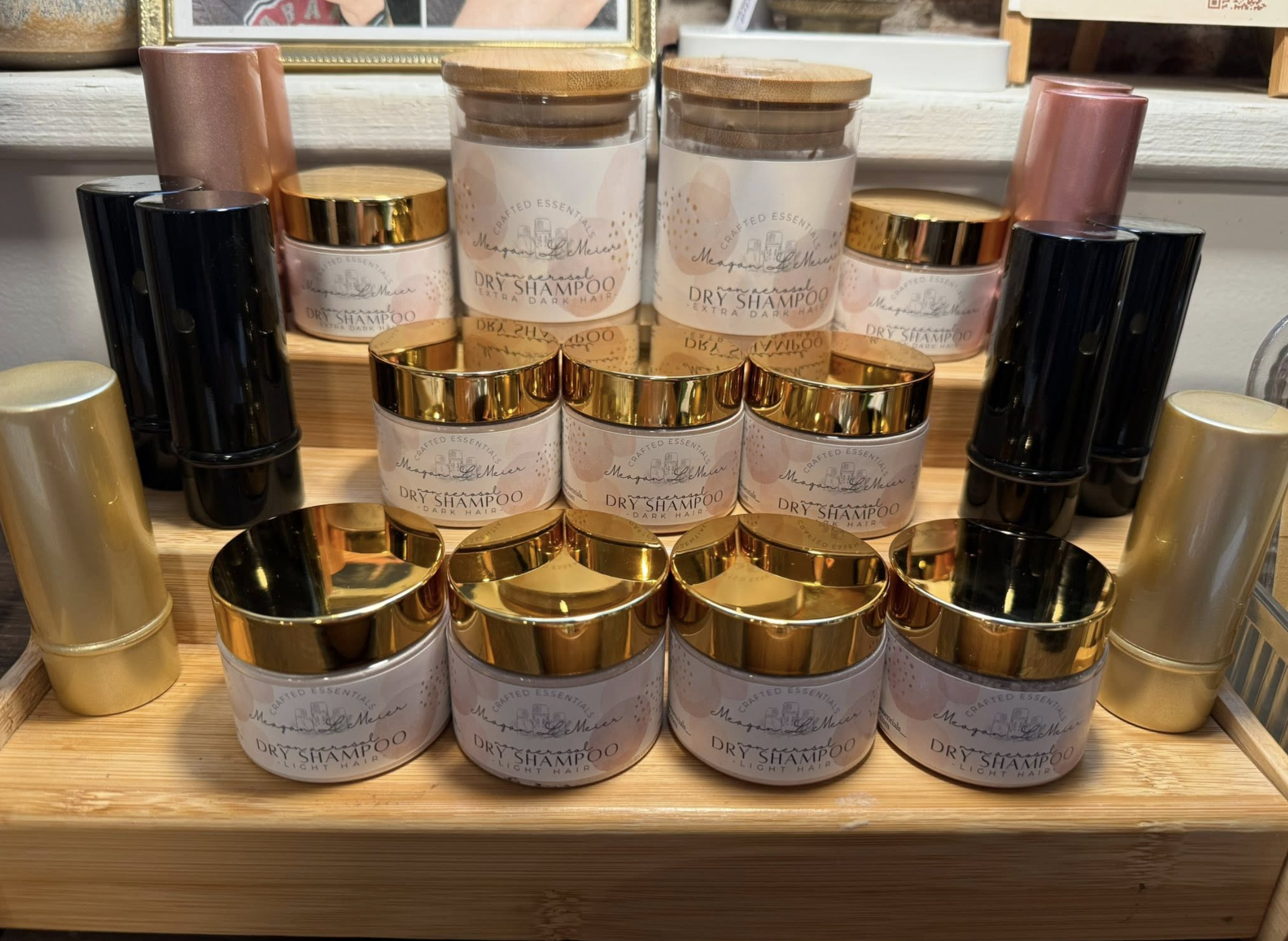
For Meagan Meier (Collinsville, IL), that evolution happened gradually through motherhood, entrepreneurship, and a growing awareness around ingredients and scalp health.
While raising young children and building businesses from home, Meier says flexibility became essential to the way she worked and lived. After success in both Keep Collective and Young Living, she found herself increasingly drawn toward creating products that aligned with a more natural approach to beauty and personal care.
“Becoming more naturally minded, and focusing on eliminating toxic ingredients in our household products is what sparked my dry shampoo, and later my whipped tallow balm, beach hair spray and glow serum into existence,” Meier says.
Rather than approaching beauty from a perfection-driven mindset, Meier’s perspective reflects something many women begin seeking in midlife: products and routines that feel supportive, manageable, and realistic for everyday life.
Stylists say lightweight dry shampoos can be especially helpful for women experiencing thinning hair because they allow women to stretch time between washes, reduce excess heat styling, and create lift without heavily coating already fragile strands.
For women adapting to changing hair texture and density, the focus often becomes less about dramatic transformation and more about learning how to support the hair they have in a healthier, more intentional way.
*Look for Meagan’s interview in GlowInto out this week!
https://www.facebook.com/CraftedEssentialsbyMeagan
To learn more about Meagan Meier’s products, including her dry shampoo, products are currently available at:
Lou Belle and Bing — Collinsville, IL
Honey Bee Vintage — Alton, IL
Collected Boutique — Carlinville, IL
Local Lucy’s — Belleville, IL
The Happy Elephant — Troy, IL
The GlowInto Reflection
Hair is rarely just hair.
For many women, it’s tied to identity, confidence, femininity, aging, and familiarity with themselves. It becomes part of how they recognize their reflection — and when it changes, even subtly, it can feel surprisingly emotional.
What makes conversations like this important is not the pursuit of perfection or youth. It’s understanding.
Understanding that many women are experiencing the same quiet shifts.
Understanding that thinning hair is often connected to larger changes happening in the body.
And understanding that there are experienced professionals, thoughtful strategies, and supportive approaches that can help women navigate those changes without shame.
Because for many women, the goal is not becoming someone new.
It’s continuing to feel like themselves.



Part 1-Janine Lange has spent her life holding on to stories, from the memories her grandfather shared at the kitchen table to the family history hidden in an old photograph from Italy. At 45, she began nursing school and persevered through a brain tumor and life-threatening complications. Now 64 and newly retired from nursing, she has claimed a title she long dreamed of: author. As Janine prepares to visit the Italian balcony in that photograph, she reflects on reinvention, resilience and the stories we carry forward.